Bearing industry report 2024
1, bearings: industrial joints, small bearings leverage billions of large markets.
Bearing is the support of mechanical transmission: the main function is to support the rotating shaft or other moving body, to rotate or move and bear the corresponding load and speed. The accuracy, performance and reliability of bearings play a key role in the performance of mechanical equipment, so its technical level directly affects the level of industrial development of a country.
According to the different friction properties of bearings, bearings can be divided into plain bearings and rolling bearings (1) plain bearings: suitable for low speed and low noise environment, mostly used in household appliances, power tools, printing machinery, motorcycles, etc.; (2) Rolling bearings: suitable for high-speed and high-load environment, mainly used in automobile, aircraft engine, machine bed, bearing and turbine and other fields.
Bearing industry chain: (1) Supply: mainly includes special steel, copper, non-metallic materials and other suppliers. (2) Demand: Widely used in industrial automation, high-end equipment, robotics, automobile manufacturing, engineering machinery, household appliances, power tools, textile machinery, agriculture and forestry machinery, national defense, energy, aerospace and rail transit and other fields.
After years of industrial competition in the global bearing industry, the formation of eight large bearing enterprises concentrated in four countries, Sweden, Germany, Japan and the United States, control the global market. Including Sweden SKF, Germany Schaeffler, Japan NSK, Japan JTEKT (JTEget), Japan NTN, the United States TIMKEN (Timken), Japan NMB (Mebea), Japan NACHI (Fujikoshi), 2020, the eight bearing enterprises accounted for 70.7% of the global market size. China is the world's third largest bearing producer, and automotive is the largest downstream application area. Automotive is the most widely used field of bearings, and the bearing consumption from the automotive industry in 2021 has accounted for 39.19% of the total bearing industry.
New energy vehicles and humanoid robots bring new bearing demand. At present, most domestic bearing manufacturers are in the first stage of the development of overseas bearing manufacturers, and the incremental demand of emerging markets represented by new energy vehicles and humanoid robots will bring the funds needed for the development of manufacturers with research and development strength and card advantages, helping these enterprises to further expand different downstream markets to expand revenue scale and resist industry fluctuations. The domestic replacement space of wind power bearings is large, and the trend of sliding instead of rolling gradually appears. China's wind power bearings mainly rely on imports, and the localization rate is low. Wind power spindle bearings and gearbox shafts are two products with higher added value, but the national production rate is still at a low level, only 32.97% and 0.58% respectively. The sliding bearing has the characteristics of strong carrying capacity, small size and simple structure, which will be one of the most potential design schemes for wind power gearbox in the future, and is expected to gradually realize "sliding instead of rolling". Machine tool bearings include main shaft bearings, lead screw bearings and drive shaft bearings, facing a larger domestic alternative space. In 2023, the global market size will reach 23.151 billion yuan, and Bezius Consulting expects the total size of the global machine tool bearing market to reach 28.948 billion yuan in 2028. Domestic high-end CNC machine tool parts self-supply rate is low, bearing manufacturers face a larger domestic alternative space.
2.1. The permeability of new energy vehicles has increased, driving the bearing demand to double
Bearings are required in the fields of drive, steering, transmission, chassis and auxiliary systems of traditional vehicles, as well as in the motors, retarders and other components of new energy vehicles. According to the official website and NSK data, a single car uses about 100 sets of bearings. According to the data of the China Bearing Industry Association, the value of a single automobile bearing is about 1500 yuan.
Compared with traditional fuel vehicles, new energy vehicles have added an electric drive assembly, which poses new challenges to bearings. The drive system of traditional fuel vehicles is replaced by an electric drive assembly in new energy vehicles. The electric drive assembly consists of a motor and a reducer. The characteristics of wide speed range, large starting torque, high power density and high efficiency of automobile drive motor make it put forward higher requirements for high speed, high and low temperature, durability, stability and reliability of bearings.
The penetration rate of new energy vehicles continues to increase, driving the market space of bearings for new energy vehicles to double.
High-end bearings for traditional fuel vehicles are dominated by bearing enterprises in the United States, Japan and Europe. The middle and high-end bearings used in automobiles include engine series bearings, long-life bearings for gearboxes such as automotive transmissions and differentials, and automotive hub unit bearings. Although some domestic automobile bearing enterprises also have production and supporting, most of them are applied to low-grade models of joint venture brands and some independent brand cars, and more than 85% of high-end bearings of high-end automobiles in China are still dominated by bearings of overseas brands. The rise of domestic new energy vehicles and the reconstruction of the customer fixed-point system bring opportunities for the localization of automotive bearings. Since 2008, when China first launched the development plan for the new energy automobile industry, the sales of domestic new energy vehicles have increased rapidly under the promotion of policy support and independent innovation of industrial chain players to improve their technical strength. Domestic bearing manufacturers cooperate with Oems in the early stage of industrial development, cooperate with the rapid iteration of new energy vehicle models, and form a binding with oems. Under the trend of Oems reducing costs, the localization rate of new energy vehicle bearings continues to increase.
2.2, the mass production of humanoid robots is imminent, and the bearing demand can be released
Bearing is one of the key parts of robot. According to the different parts of the robot joint, it can be divided into harmonic reducer bearings, RV reducer bearings, planetary reducer bearings, and planetary roller screw bearings.
(1) Joint bearing
Humanoid robots make extensive use of joint bearings. The humanoid robot uses cross roller bearings, angular contact bearings and flexible bearings for rotating joints. Linear joints use four-point contact bearings and deep groove ball bearings. Among them, the manufacturing of cross roller bearings is the most difficult, and there are few domestic mass production enterprises. Angular contact bearings, four-point contact bearings have a certain degree of difficulty, can be supplied in the country, the price is far lower than imports, accuracy is lower than imports; Deep groove ball bearing technology is mature, stable domestic supply, the price is far lower than imports.
The rotary joint can be divided into three parts according to the speed: the fixed part of the shell, the high-speed motor shaft, and the low-speed output shaft. Cross roller bearings are installed in the housing fixed part and low speed output shaft. Need to withstand all the forces and torque outside the torque of the reducer, requiring extremely strong rigidity. Cross roller bearings are deformed and can be turned into cross roller guides after straightening. The cylindrical rollers are arranged vertically across each other at 90°, and the vertical rollers are isolated through the isolation block. It can be subjected to radial and axial forces, with smaller clearance and greater load. The cross roller bearing in the harmonic reducer is also called thin wall bearing, and the processing difficulty is in the resistance to change of thin wall. Angular contact bearings: Bearings used between the fixed part and the high-speed motor shaft, which can withstand high rotation speed and can also withstand a certain axial force. Usually used in pairs, providing different axial forces.
According to the speed, the linear joint is divided into the fixed part of the motor (1), the rotating part of the motor + the screw nut part (2) and the lead screw part (3). Among them, a four-point contact bearing and a deep groove ball bearing are used between ① and ②. The role of the two bearings is to separate and support the high speed part and the fixed part. The four-point contact bearing overcomes the shortcomings of the deep groove ball bearing.
(2) reducer bearing
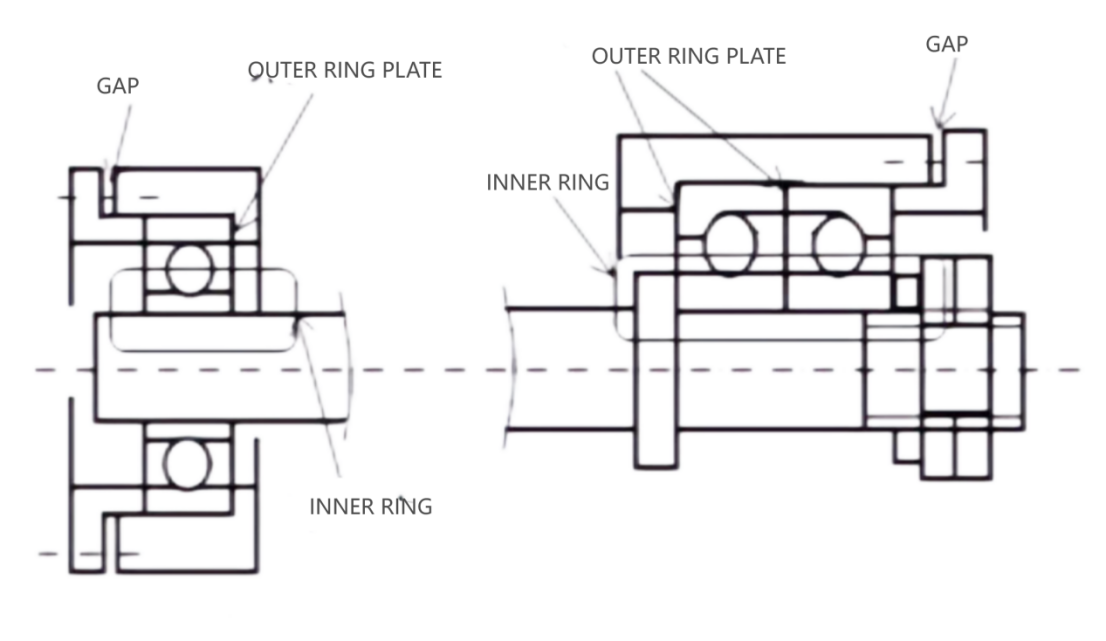
At present, there are mainly two kinds of reducer used in robots: harmonic reducer and RV reducer. The bearings used for harmonic reducer mainly include cross roller bearings and flexible bearings, and the RV reducer mainly uses angular contact ball bearings. The cross roller bearing for harmonic reducer contains four series, CSG(CSF) series, CSD series, SHG(SHF) series, SHD series, and its naming method adopts the naming of the reducer; Harmonic reducer with flexible bearing named HYR, RV reducer main bearing named RV. CSF/CSG series cross roller bearings for harmonic reducer are different from standard cross roller bearings in appearance and heat treatment process. Compared with the standard cross roller bearings, the inner and outer rings have three layers of different sizes and numbers of mounting thread holes, which are different from the basic type cross roller bearings in appearance; In addition, the heat treatment of the outer ring of the bearing uses the integral quenching process, and the inner ring uses the raceway surface high-frequency quenching process, which is the main difference between the process and the ordinary cross roller bearing. SHF/SHG series harmonic reducer and SHD series harmonic reducer with cross roller bearing inner and outer rings are integral structure. SHF/SHG type installation has almost no impact on performance, can obtain stable rotation accuracy and torque, mainly used in the SHG and SHF series of various types of reducer output parts. SHD type height is lower than SHG, saving the installation space of the reducer, mainly used in the output part of the SHD reducer.
Flexible (HYR) bearing is the main component of harmonic reducer, and its accuracy and stability directly determine the function of harmonic reducer. Flexible bearing in the work, the inner ring is installed on the elliptical CAM, work to bear the cyclic stress load, the outer ring is installed on the flexwheel, work with the rotation of the CAM and elastic deformation, not only bear the cyclic stress load, but also bear the alternating stress load.
(3) Lead screw bearing
The lead screw is a key component in many machine tools such as lathes, milling machines and grinders. They are used to convert rotational motion into linear motion and are essential for providing smooth, accurate motion. Lead screw bearings support the lead screw and help reduce friction. There are many different types of lead screw bearings, including ball bearings, roller bearings, sleeve bearings, hydrostatic bearings, etc. (1) Ball bearings are the most common type of lead screw bearings. They consist of two sets of balls and seat rings, and are held together by cages. Ball bearings provide excellent performance in terms of load capacity, speed and accuracy. (2) Roller bearings are another type of lead screw bearings. They consist of a series of rollers arranged in a cylindrical or conical shape. Roller bearings provide good performance in terms of load capacity and speed, but are not as precise as ball bearings. (3) Sleeve bearing is the third type of lead screw bearing. They are made of a piece of metal that is shaped to fit around the lead screw. Sleeve bearings provide good performance in terms of load capacity and speed, but are not as accurate as ball or roller bearings. (4) Hydrostatic bearing is the fourth type of lead screw bearing. They consist of a series of small flow chambers arranged around the lead screw. Hydrostatic bearings offer very high accuracy, but they are also the most expensive type of lead screw bearings. In addition to the four main types of lead screw bearings, there are also thrust bearings, anti-friction bearings, composite bearings and other categories, and the appropriate bearing varieties will be selected according to the specific application needs. Ball screw bearings or ball screw support bearings are specialized bearings specifically designed to support high axial loads and provide precise motion control in ball screw assemblies. These bearings usually include angular contact ball bearings or deep groove ball bearings, which help the ball screw system effectively transfer the rotating motion to linear motion, usually used in a variety of humanoid robot application scenarios, in industrial, home and other application scenarios have a broad space for development, belongs to the trillion-level market space industry, 2024 is expected to be the first year of mass production of humanoid robots. When Tesla humanoid robot shipments reach 1 million units, the joint bearing market size will reach 3.5 billion yuan, in addition, because the humanoid robot joint bearings will be replaced regularly, the total market space will be larger in the future.
2.3. The installed capacity of wind power maintains a high increase, and large scale brings the demand for plain bearings
Wind power bearings are mainly rolling bearings, and the large-scale trend drives the demand for plain bearings
The installed capacity of wind power has maintained high growth. From 2000 to 2023, the domestic new wind power installed capacity CAGR reached 34.8%, and the global new wind power installed capacity CAGR reached 16.1%, maintaining a high growth trend.
Wind turbine bearing is a special bearing, the use of harsh environment, high maintenance costs, high life requirements. Wind power bearings mainly include yaw bearings, variable pitch bearings, main shaft bearings, transmission bearings, generator bearings. Each wind turbine equipment includes: 1 set of yaw bearings, 3 sets of variable pitch bearings, 2 sets of generator bearings, 2 sets of gear box bearings and 1 set of main shaft bearings. Doubly-fed and semi-direct drive fans have transmission bearings, the demand of which varies according to the transmission structure. The structural forms of wind turbine bearings are mainly rolling bearings, including four-point contact ball bearings, cross-fork roller bearings, cylindrical roller bearings, self-aligning roller bearings and deep groove ball bearings. The friction of rolling bearings is less than that of plain bearings, and the energy saving effect is significant. The general small ball mill using rolling bearings for main bearings saves electricity up to 30%~35%, the medium-sized ball mill saves electricity up to 15%~20%, and the large ball mill saves electricity up to 10%~20%. However, the working conditions of wind turbines are usually harsh, and need to face a large range of temperature, humidity and bearing load variation, and up to 23m/s impact load, therefore, wind turbine bearings have strict requirements for sealing and lubrication, impact resistance, service life and reliability, and the trend of "sliding instead of rolling" has gradually emerged in recent years.

