Categories
The Critical Role of Bearings in Enhancing Humanoid Robot Performance
This article, in conjunction with the previous one, focuses on introducing the characteristics of RV reducer bearings, planetary reducer bearings, and lead screw bearings, as well as their applications in humanoid robots.
Apr 21st,2025
591 Views
The joints of humanoid robots can realize rotation and linear motion, which is inseparable from the key role of bearings. In humanoid robots, bearings are mainly distributed in the connection parts of the deceleration device and joints to provide support for the flexible movement of the robot.This article, in conjunction with the previous one, focuses on introducing the characteristics of RV reducer bearings, planetary reducer bearings, and lead screw bearings, as well as their applications in humanoid robots. RV Reducer Bearings The RV reducer, also known as a rotary vector reducer, consists of a front-stage planetary gear reducer and a rear-stage cycloidal pinwheel reducer. This transmission mechanism is an advanced evolution of classic cycloidal planetary drive technology, offering advantages such as compact size, lightweight, wide speed ratio range, long service life, stable precision retention, high efficiency, and smooth operation.Compared to harmonic drives, RV reducers demonstrate superior fatigue strength, rigidity, and longer lifespan, with minimal degradation in motion accuracy over time. Due to these advantages, RV reducers are gradually replacing harmonic drives in high-end robotic transmission applications.RV reducers employ three types of bearings: - Thin-walled angular contact ball bearings** (for the main bearing, output shaft, 2 units) - Thin-walled tapered roller bearings** (for eccentric shaft positioning and main support, 3×2 units) - Cylindrical roller (needle) cage assemblies** (for cycloidal gear support, 3×2 units) - Thin-walled deep groove ball bearings** (for gear support)Planetary Reducer Bearings The planetary reducer is the most efficient gear transmission structure, primarily composed of planetary gears, a planet carrier, and a sun gear. During operation, a servo motor typically drives the sun gear, which engages with the planetary gears, causing them to rotate on their own axes. Simultaneously, the planetary gears mesh with an internal ring gear on the reducer housing, making them "revolve" around the sun gear while rotating. The difference in tooth count between the sun gear and ring gear achieves speed reduction. Planetary reducers use three types of bearings: planetary gear bearings, main bearings, and input shaft bearings. Each planetary gear contains a needle roller bearing (3 per reducer), while the main and input shaft bearings (typically deep groove ball bearings) are mounted at both ends. Thus, a planetary reducer requires 5 bearings in total: 3 needle roller bearings and 2 ball bearings. For example, the Tesla Optimus Gen-2 robot employs deep groove ball bearings and needle roller bearings in its planetary reducers. The deep groove ball bearings handle minor radial and axial loads, while the needle roller bearings support the high radial loads generated by the planetary gears during high-speed rotation.Lead screw & bearingThe lead screw is a transmission element that converts rotational motion into linear motion, providing precise positioning and motion control for the joint. The screw type mainly includes ball screw and planetary roller screw, etc.: ball screw is composed of screw shaft and nut, of which nut is composed of steel ball, prepressure sheet, reverse device, dust preventer, etc.; Planetary roller screw is mainly composed of screw, roller, nut, inner gear ring, cage and elastic stop ring, relying on a plurality of rollers and screw, screw and nut between the thread meshing drive to convert the rotating motion of the servo motor into linear motion, the roller through the cage evenly distributed between the screw and nut.Learn more about high-performance bearings.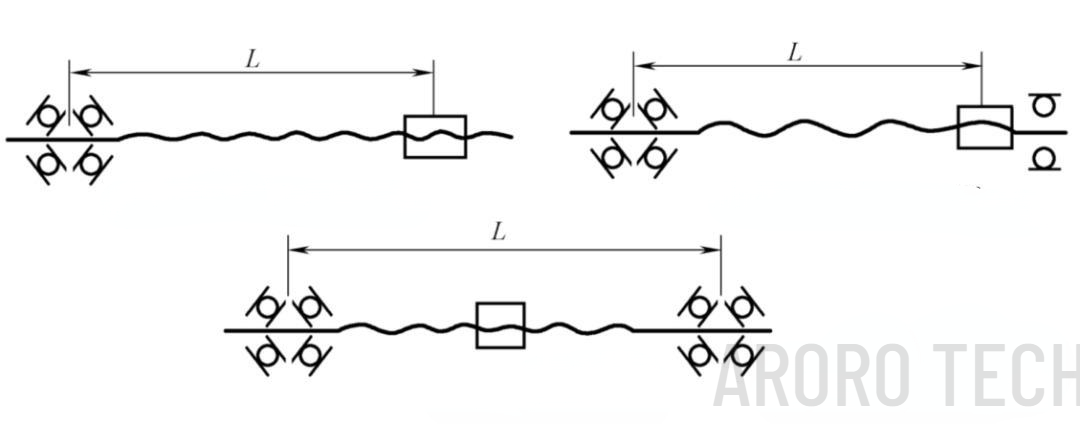 Currently, lead screws are primarily installed in three main configurations (as shown in the diagram above). Depending on the installation method, two types of bearings are typically combined for support. For example, a radial bearing can be paired with a tapered roller bearing, or a radial bearing can be combined with a thrust bearing/angular contact bearing. This ensures that the thrust bearing or angular contact bearing provides sufficient axial stiffness. Four-point contact ball bearingsFour-point contact ball bearings, also known as angular contact ball bearings that can withstand two-way axial loads, belong to a kind of angular contact ball bearings, with lower barriers and smaller values. This bearing is a single row angular contact ball bearing with the inner and outer rings separated, and the inner ring is divided into two parts, which can withstand axial loads from both directions at the same time. The groove curvature radius of the outer ring is very small, so that the steel ball and the inner and outer rings are in uniform contact at four contact points, and the rolling body has four stress points, so it is called a four-point contact ball bearing, which has a high carrying capacity.Compared with ordinary angular contact ball bearings, four-point contact ball bearings haveCompared with ordinary angular contact ball bearings, four-point contact ball bearings have smaller axial clearance, and can even achieve negative clearance, and can withstand two-way axial loads. It is suitable for bearing both radial and axial loads, especially in the case of axial loads. If a single row angular contact ball bearing is used to achieve the same function, it is usually necessary to configure two identical bearings back-to-back or face-to-face. The four-point contact ball bearing design can effectively save space and provide a more concise layout scheme.

